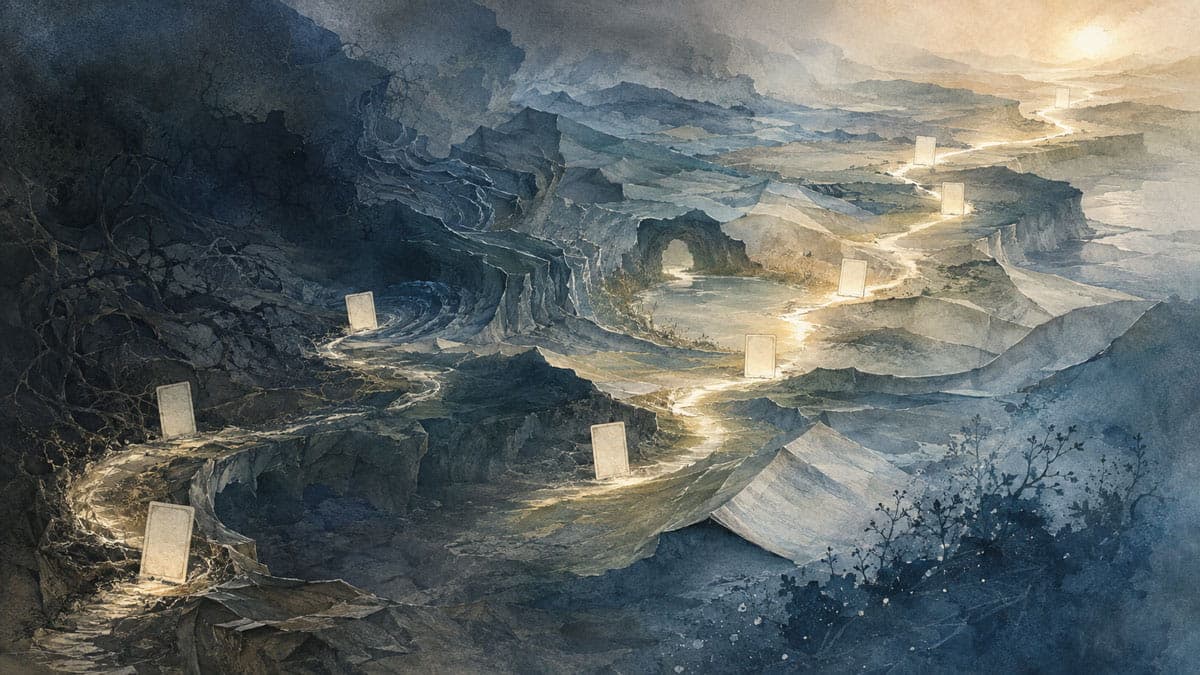
Every story you've ever loved probably follows a similar shape: someone ordinary is pulled out of their familiar world, faces trials, meets guides and obstacles, endures a hard middle, and comes back changed. Joseph Campbell called this the hero's journey — and its staying power isn't really about adventure stories. It resonates because it describes how people actually change.
Used as a reflective frame, it can turn a confusing stretch of life into something with shape and direction. Here's how to map your own journey with metaphorical cards.
Why This Frame Helps
When you're inside a difficult transition, it rarely feels like a story. It feels like mess — uncertainty, false starts, days you can't explain to anyone. The hero's journey offers something valuable: the reminder that the mess has a shape, and that the disorienting middle is a stage rather than a permanent condition.
It also reframes difficulty. In the story structure, the trials aren't interruptions of the journey; they're the substance of it. That shift alone — from "this shouldn't be happening" to "this is the part where things get tested" — can change how a hard period feels to live through.
The Stages, Simplified
Campbell's full model has many steps. For reflection, a handful is plenty:
- The ordinary world — where you were before, and what felt normal.
- The call — the event or restlessness that made staying impossible.
- The refusal — the hesitation, fear, or reason you almost didn't go.
- The threshold — the point of no return, where you actually left the old shore.
- Trials and allies — what tested you, and what or who helped.
- The heart of it — the hardest moment, the thing you had to face.
- The return — coming back, changed, and what you carry with you.
Why Map It with Cards
You could write these stages as a list, but something different happens when each one gets an image. A card gives a stage a felt quality that words tend to flatten — you might know the call was a job ending, but the image you choose for it can reveal whether it felt like a door slamming or a door opening.
Laying the cards out in a row also externalizes the whole arc. You stop being inside the story and start looking at it, which is exactly where perspective comes from. And since these cards carry no fixed meanings — nothing to decode, nothing predicted — every stage means only what you see in it.
The Journey Spread
Give yourself half an hour. Pick a specific journey to map: a career change, the end of a relationship, an illness, a move, becoming a parent, or simply the last two years.
1. Lay out the stages
Decide which stages you're mapping — five to seven works well. Set out a position for each, left to right.
2. Draw a card for each
Go one at a time, in order. Pull a card for the ordinary world, then the call, and so on. Don't interpret as you go; just place them.
3. Walk the row
Now return to the beginning and take each card in turn. For each, ask:
- What's the mood of this image?
- What does it show me about this stage that I hadn't put into words?
- What did this stage cost me, and what did it give?
4. Read the whole arc
Step back and look at all the cards together. Where does the row feel heaviest? Is there a stage you're still standing in? Does the ending look like an ending, or does the arc seem to be waiting for something? The layout as a whole usually says something no single card does.
If You're Still in the Middle
Most people who try this aren't looking back from a tidy ending — they're somewhere in the trials, which is precisely when it's most useful. Two adjustments help:
- Mark where you are. Identify which stage you're currently standing in. Naming it is often a relief in itself.
- Pull for what's ahead. Draw a card for the next stage as a question, not a prediction — "what might this ask of me?" You're rehearsing possibilities, not forecasting. Nothing here tells your future.
A Few Notes
- You don't have to feel heroic. The frame isn't about triumph. Surviving the middle counts.
- Journeys overlap. You can be in the return of one story and the call of another. That's normal.
- Go gently with hard chapters. If mapping a painful period stirs more than you expected, slow down — and consider walking through it with a therapist or coach rather than alone.
Map Yours
Open, evocative imagery works best across a long spread. Doors & Thresholds is a natural fit for the crossing points, Resources for allies and strengths, and Essence for the heart of the journey. A browser board lets you lay the whole arc out and rearrange it as the story clarifies.
Short on time? Pull a free daily card and ask, "which stage of the journey am I in right now?"
Explore all decks on MindTrays
— MindTrays Team
Try it in your browser
Open a deck, lay out a single card, and start a quiet reflection — on your own or with someone, in real time.