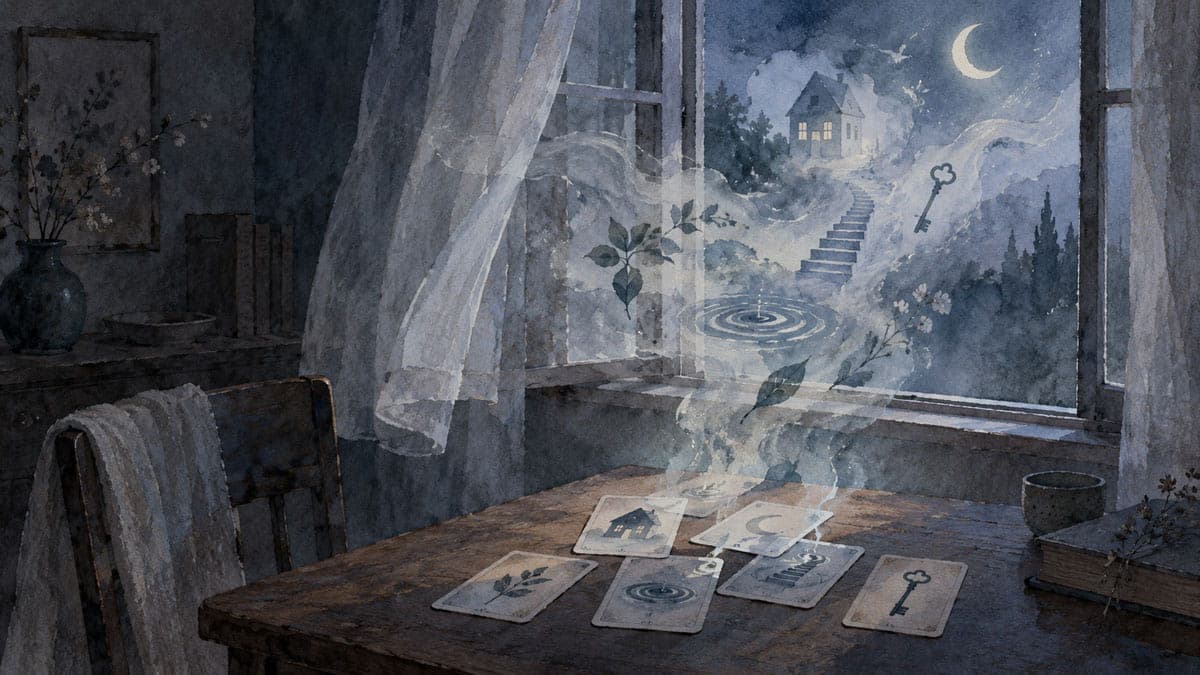
You wake up with the residue of something vivid — a house you've never lived in, a person you haven't seen in years, a feeling you can't name. Within minutes it's slipping away. Most of us shrug and get on with the day, which is a shame, because dreams are one of the few places where the mind speaks without editing itself.
You don't need to decode dreams to benefit from them. Here's a gentler approach — working with the images a dream leaves behind, using cards to keep them alive long enough to say something.
Why Dreams Are Worth Your Attention
Whatever else is happening neurologically, dreams have a quality waking thought lacks: they're unfiltered. Your daytime mind smooths things over, keeps a tidy story about who you are. Dreams don't bother. They present situations, images, and feelings without the usual explanations attached — which is exactly what makes them useful for self-understanding.
They're also emotionally honest in a way that can be startling. A dream about a locked room may tell you more about how a situation actually feels than anything you'd say about it out loud.
Forget the Dream Dictionary
The most common mistake is looking up what a dream "means." Search for teeth falling out or being chased and you'll find confident universal answers — and they'll almost certainly mislead you.
A dream image means what it means to you. A dog is warmth and loyalty to someone who grew up with one, and pure fear to someone who was bitten as a child. The same image, opposite meanings, both correct. This is why the useful question is never "what does this symbolize?" but "what does this remind me of, and how did it feel?"
Worth saying plainly, since dream work attracts this assumption: none of this is divination. Nothing in a dream predicts anything, and no card you draw alongside it does either. You're exploring your own associations, not receiving a message.
Why Pair Dreams with Cards
Dreams fade fast, and they resist description — try explaining one and you'll usually feel how much gets lost in the retelling. Cards help in two ways.
First, an image holds an image better than a sentence does. If your dream had a heavy, closed-in quality, a card with that same quality lets you keep hold of it while you think, instead of watching it evaporate into words.
Second, cards can extend a dream. Drawing a card and asking "what else does this dream want to show me?" often surfaces associations the dream itself only hinted at. Because metaphorical cards carry no fixed meanings, whatever appears comes from you — the same place the dream came from.
A Practice for Working with a Dream
Do this soon after waking if you can, or any time you're still carrying a dream.
1. Catch the fragments
Write down whatever remains — even three disconnected details. Don't try to reconstruct a plot. Images, feelings, and fragments are the material; the storyline rarely matters.
2. Name the feeling, not the events
Ask what the dream felt like: unsettled, urgent, tender, absurd, sad. The emotional tone is usually the most reliable thing a dream gives you.
3. Find a card that matches
Pull cards until one carries a similar quality to the dream, or look through the deck and choose deliberately. You're not looking for a picture of the dream — you're looking for its atmosphere.
4. Let the card open it out
With the card in front of you, ask:
- What does this remind me of in my waking life?
- Who or what in my life carries this same feeling right now?
- If the dream were pointing at something, what would it be pointing at?
5. Draw one more for what it's asking
Finally, pull a card for what the dream might be inviting you to notice. Write a couple of lines. You're not solving the dream; you're letting it finish its sentence.
For Recurring Dreams
If a dream keeps returning, it usually means something unresolved is still asking for attention. Try laying out two cards: one for the dream as it always goes, and one for what would need to change for it to end differently. The second card often points at something quite practical in waking life.
A Few Notes
- Not every dream is significant. Some are just the mind sorting the day. Work with the ones that stay with you.
- Trust the strange details. The odd, incongruous element is often where the life is — not the parts that make narrative sense.
- Keep a record. Patterns across weeks say more than any single dream.
- Go gently with nightmares. Distressing or recurring nightmares, especially after difficult experiences, are worth exploring with a therapist rather than alone.
Try It Tomorrow Morning
Keep a deck within reach and, next time you wake with something lingering, catch a fragment and find the card that matches its mood. Textures & Abstractions is well suited to dream atmospheres that have no clear picture, while Essence offers layered imagery for dreams with more content.
Or start smaller — pull a free daily card and ask it what last night was trying to say.
Explore all decks on MindTrays
— MindTrays Team
Try it in your browser
Open a deck, lay out a single card, and start a quiet reflection — on your own or with someone, in real time.