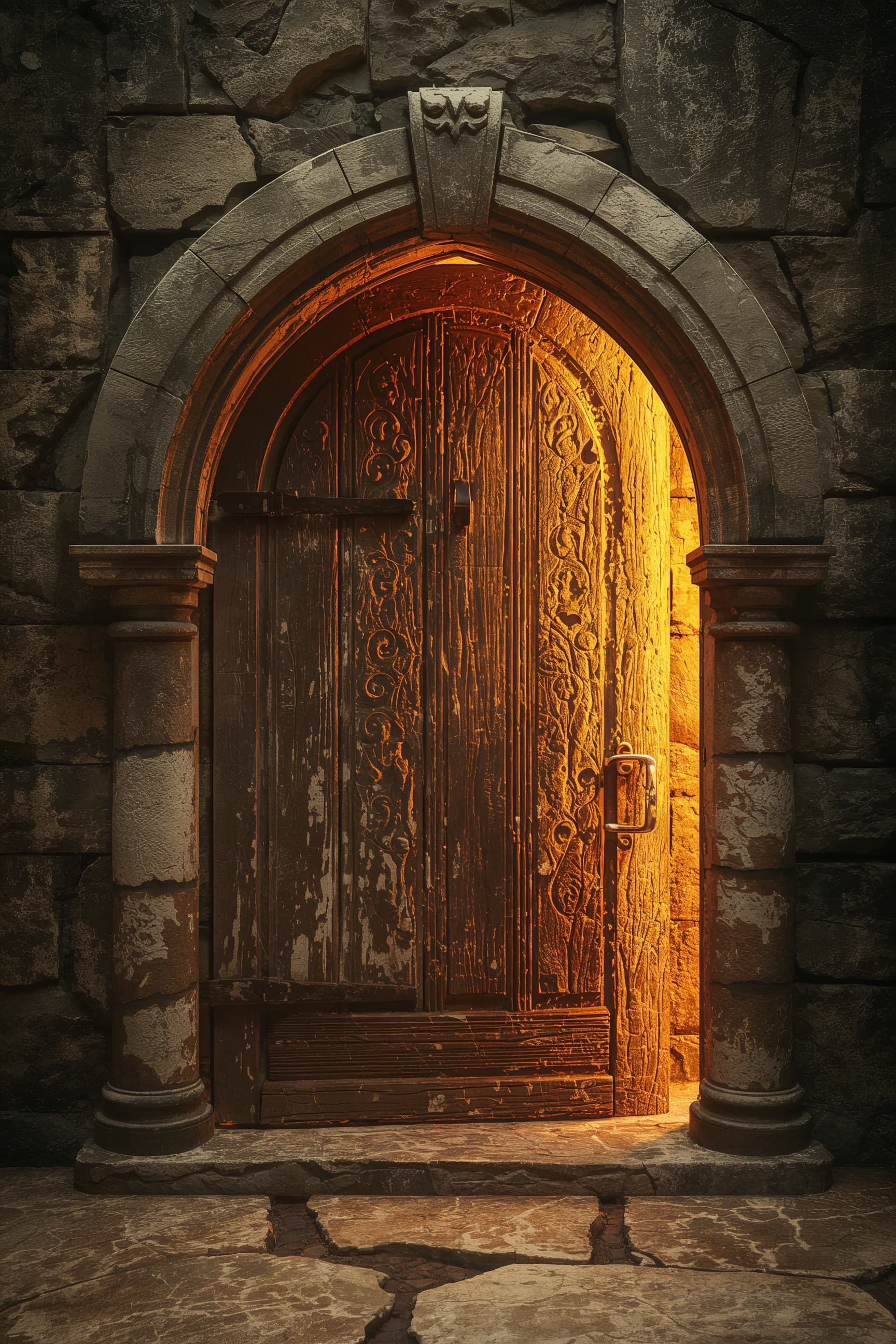
Every meaningful change passes through a threshold. Leaving a job, ending a relationship, becoming a parent, starting over in a new city — each one asks you to step from something familiar into something not yet known. Doors & Thresholds is a deck built for exactly those moments: the passages, choices, and in-between spaces where so much of real life actually happens.
With around 45 cards of doorways, gates, corridors, openings, and the spaces just beyond them, this deck gives transition a visual language — so it can be explored rather than simply endured.
The Concept: The Threshold as a Mirror for Change
A door is one of the oldest human symbols. It marks a boundary between here and there, before and after, known and unknown. A threshold is the moment of crossing — the pause on the doorstep when you haven't quite left and haven't quite arrived.
Doors & Thresholds turns these images into open metaphors. A heavy closed door, a gate standing ajar, a long hallway of identical doors, a bright opening at the end of a passage — each card invites a different relationship to change. None of them carries a fixed meaning. That's the point.
It's worth saying clearly, because doorway imagery can feel symbolic in a tarot-like way: this is not tarot. The cards have no set interpretations and no accompanying booklet. A closed door might read as an obstacle to one person and as welcome privacy to another. A threshold might feel like fear, or like possibility, depending entirely on who is looking. The meaning lives in the viewer, not the card.
Three Ways to Use Doors & Thresholds
1. Naming Where Someone Is in a Transition
Ask the client to choose a card for where they are right now in a change they're facing. Are they still inside the old room? Standing at the threshold? Halfway down the corridor? The image often surfaces a truth that's hard to say directly — that they've already left, or that they're not as ready as they thought.
Useful prompts:
- What part of this image feels most like your situation?
- What's on the other side of this door, as far as you can tell?
- What's keeping you on this side of it?
2. Working With Choice and Direction
When someone faces a decision, invite them to lay out several door cards as the options in front of them. Which one draws them? Which one do they avoid? The pull toward or away from an image can reveal desires and fears that pro-and-con lists tend to flatten.
3. Honoring Endings and Beginnings
Transitions involve loss as well as arrival. Use one card for what is closing and one for what is opening, and let the client speak to both. This is especially powerful in closure work — the end of therapy, a career chapter, or a relationship — where naming the ending makes the new beginning more possible.
A Glimpse Into the Deck
“The Half-Open Door”
A door left ajar, with soft light spilling through the gap. For one person it's an invitation; for another, the unfinished business of something not fully closed. The ambiguity is what makes it useful.
“The Long Corridor”
A passage lined with doors, stretching further than the eye can follow. It can speak to overwhelm and too many options — or to a journey with more chapters still ahead.
Who It's For
Doors & Thresholds is designed for coaches working with career and life transitions, therapists supporting clients through change and closure, facilitators, and anyone using cards for their own reflection at a crossroads. Wherever a person is moving from one chapter to the next, these images give the passage a shape they can look at, describe, and move through.
The deck is ready to explore now — spread it, shuffle it, flip and arrange the cards right in your browser, on your own or live with a client.
Try it in your browser
Open a deck, lay out a single card, and start a quiet reflection — on your own or with someone, in real time.