The Figures deck is a set of 50 silhouette cards for exploring roles, relationships and inner dynamics. Because the figures have no faces, ages or clothes that tell a story, people project their own meaning onto them — which makes the deck useful for mapping families, teams and the different parts of yourself without needing the right words first.
What makes a silhouette useful
A detailed portrait invites commentary: "she looks tired", "he seems angry". A silhouette invites something else. With only posture, distance and direction to go on, the person looking fills in the rest from their own experience. That is projection doing its quiet work, and it is the reason the Mindtrays Figures deck feels both simple and surprisingly revealing.
Some cards show a single figure — standing tall, turned away, curled up, reaching. Others show two or more figures close together, far apart, facing each other or facing the same way. None of them carries a fixed meaning. The same pair of figures can read as "support" to one person and "being watched" to another, and both readings are worth talking about.
Like every metaphorical card deck, Figures predicts nothing. It is not a Tarot deck and there is no guidebook of "correct" interpretations. The meaning belongs to the person holding the card.
Three ways to work with the Figures deck
1. Who am I in this relationship?
Lay the cards face up and ask: "Choose a figure that shows how you are in this relationship right now." Then: "Choose one for how you would like to be." The gap between the two cards is usually where the conversation lives. Useful follow-up questions:
- What is this figure doing with its body?
- What would it need to move from the first card to the second?
- Who else is in the picture, even if they are not on the card?
2. Mapping the space between
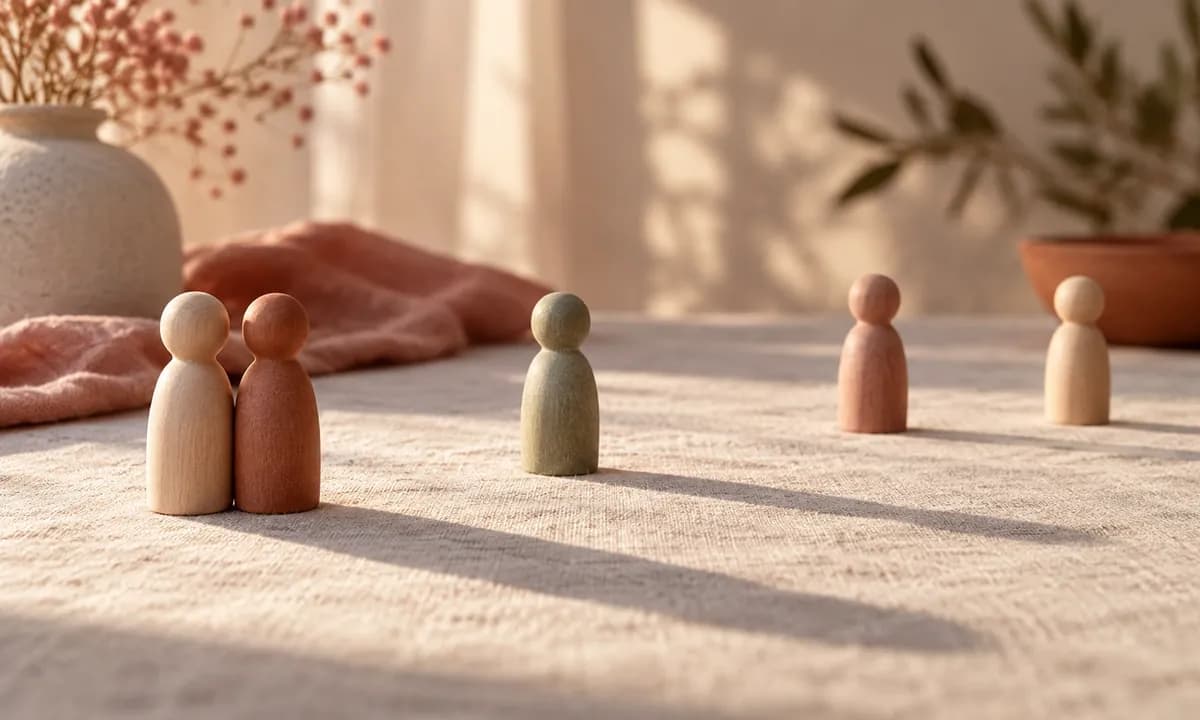
Ask the client to pick one figure for themselves and one for each important person — a partner, a parent, a colleague — and place them on the table. Distance, angle and who faces whom often say more than the cards themselves. Then try moving one card: "What changes if this figure turns around? Steps closer? Steps back?" This works well in family and couples work, and pairs naturally with the approaches in our guide to relationship cards for couples.
3. A council of parts
Silhouettes are a gentle way into parts work. Invite the person to choose a figure for the part of them that pushes forward, one for the part that holds back, and one for the part that watches. Let each "speak" for a moment. Because the figures are anonymous, people often find it easier to give a voice to a critical or frightened part than they would with a realistic image. For more on this approach, see parts work with metaphorical cards.
Where the deck fits best
- Therapy and counselling: family systems, attachment themes, boundaries, feeling invisible or overexposed.
- Coaching: team roles, leadership presence, "where do I stand in this organisation?"
- Groups and workshops: each participant picks a figure that shows how they arrive today — a quick, low-pressure check-in. Our group warm-ups post has more ideas.
- Self-reflection: a weekly pull of "who was I this week?" in a journal.
Using it online
Placement matters with this deck, and that is easy to lose on a video call. In collaborative mode, both you and your client see the same table and can move figures closer or further apart in real time, so the map of a relationship builds itself on screen rather than in a description.
For the skeptic
A fair question: is this just reading tea leaves with extra steps? Not quite. The cards do not add information — they slow the conversation down and give people something to point at. Many clients find it easier to say "this one is me, and she's standing too far away" than to explain a complicated relationship from scratch. The limits are real, too: the deck will not resolve a conflict on its own, and with someone in acute distress a structured, grounded approach comes first. Used as a prompt, not an oracle, it simply makes the invisible a little more visible.
Try it
Open the Figures deck and pull one card with a single question: "Where do I stand right now — and with whom?" If you want a gentler daily habit, start with a card on MindTrays Daily, or browse all our decks to find the one that fits your work.
— MindTrays Team
Try it in your browser
Open a deck, lay out a single card, and start a quiet reflection — on your own or with someone, in real time.