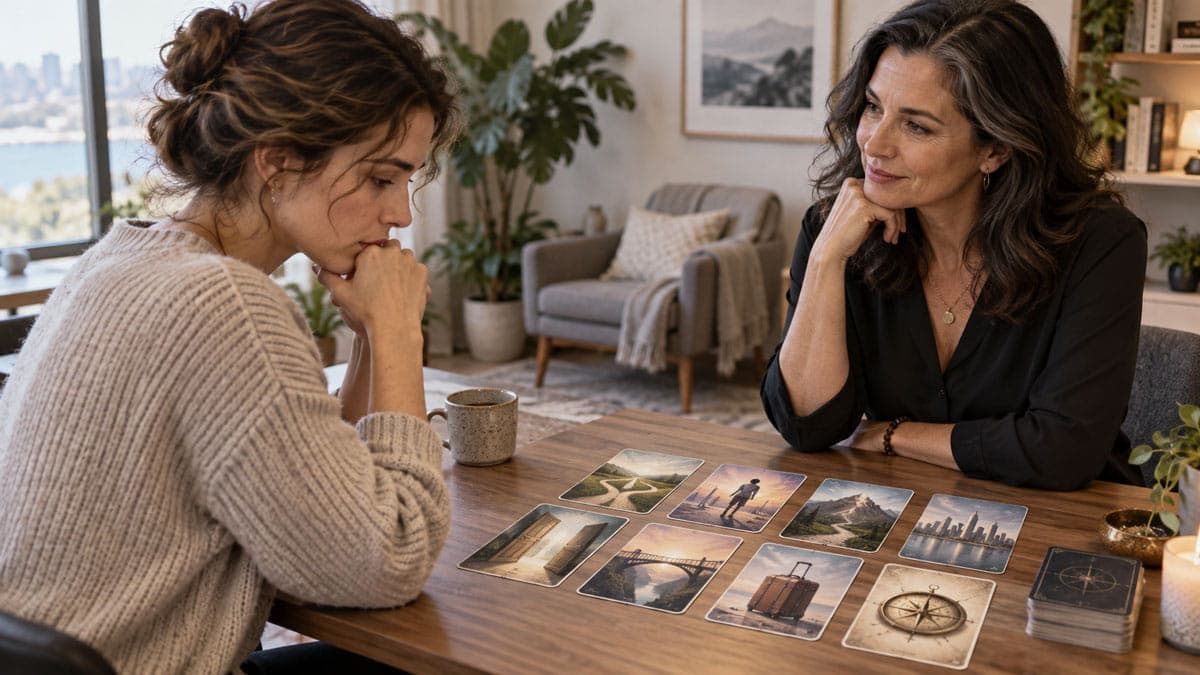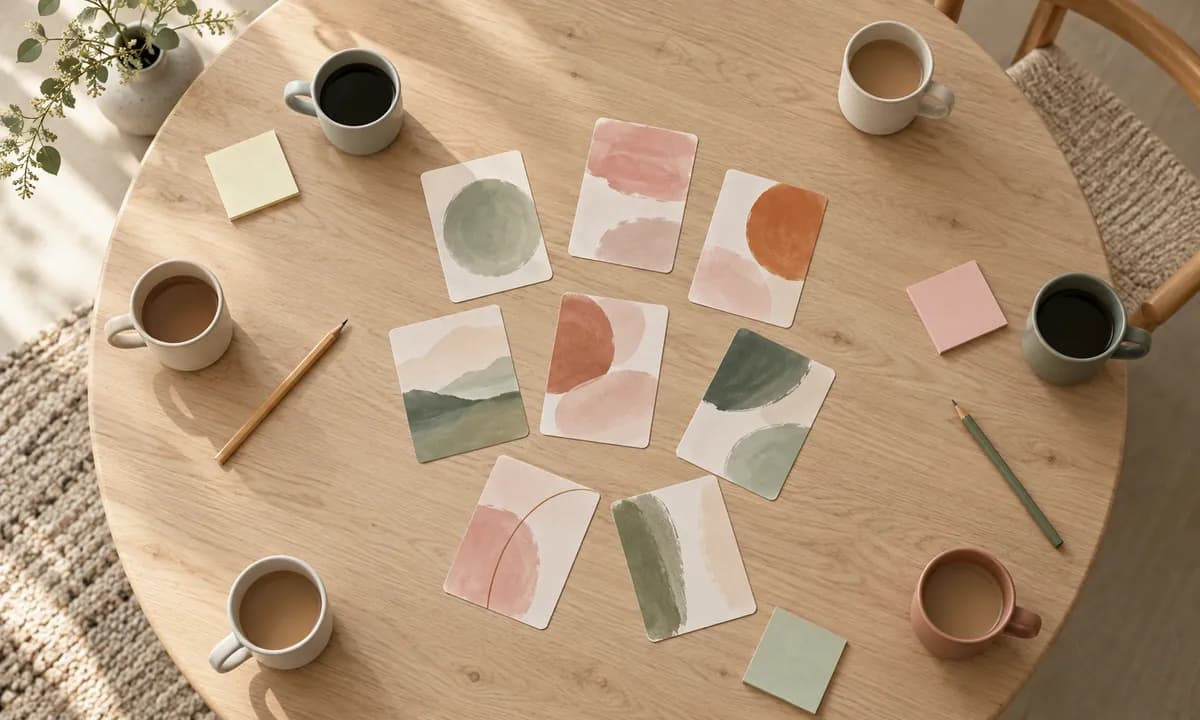
Ask a team how a project really went and you'll get careful answers. People manage what they say in front of colleagues and managers — not from dishonesty, but because workplaces have politics, and nobody wants to be the one who says the difficult thing first. Facilitators know the feeling: a room full of reasonable comments and a nagging sense that the real conversation is happening somewhere else.
Metaphorical cards are a practical way through that. Here's how to use them in team workshops and organizational sessions.
Why Images Loosen a Guarded Room
A card creates a small but useful layer of indirection. Saying "I think leadership has been unclear" is a risk. Saying "I picked this card — it's foggy, you can't quite see the path" says the same thing with the image carrying part of the weight. It's easier to offer, and easier for others to hear without defensiveness.
Cards also equalize the room. In most team discussions the same three confident voices dominate. When everyone picks a card and shares a sentence, the quieter people contribute on equal footing — and their contributions are frequently the ones that shift the conversation.
And because there are no wrong answers, participants can't fail at the exercise. That matters in a work context where people are constantly, quietly being evaluated.
Where Cards Fit in a Workshop
Opening check-in
Each person picks a card for how they're arriving, or how the past quarter has felt. Fast, and it tells you more about the room's actual state than any agenda item. Cap it at a sentence each so it doesn't consume the session.
Taking the temperature
A card for how our team feels right now, shared around the group. Laying the cards out together makes the collective mood visible — and any striking divergence in the room becomes an honest, non-accusatory starting point for discussion.
Reviewing a project
Three cards each: how the project began, the hardest part, and where it landed. Far more revealing than a standard retrospective, because people surface feelings about the work that a timeline review never touches.
Shared vision
Each person picks a card for where we should be heading, then the group arranges them and looks for common ground. Discovering that six people chose images with similar qualities — or strikingly different ones — is a fast, concrete way to see whether a team actually shares a direction.
Naming what's in the way
A card for the obstacle nobody's naming. This one needs a safe room and a facilitator who can hold what comes, but it can unlock conversations a team has been avoiding for months.
Roles and relationships
For teams with dynamic issues, a card for "my role here" or "how I experience working with this team" surfaces patterns — the person who feels invisible, the one carrying too much — that org charts hide.
Facilitation Notes
- Frame it in thirty seconds. Say plainly: the images have no fixed meanings, this isn't tarot or a personality test, and there's no right answer. Corporate rooms need that reassurance before they'll engage.
- Model it first. Share your own card briefly. The tone you set is the tone you get.
- Mind the power in the room. If a manager is present, people will self-censor to some degree. Consider whether leadership should participate, observe, or step out — and be honest with yourself about what the room can safely hold.
- Let people pass. Voluntary participation keeps it safe and, paradoxically, increases participation.
- Don't interpret anyone's card. Especially not a colleague's. Each person speaks only to their own image.
- Keep it moving. One sentence per person in a group of twelve is plenty. Depth comes in the discussion afterward.
- Know the limits. Cards can open genuine distress. If something surfaces that belongs in a private conversation or with a professional, handle it outside the workshop.
Remote and Hybrid Sessions
Distributed teams are where this gets most useful, because remote workshops struggle exactly where cards help — reading the room and getting quieter voices in. A shared visual board gives everyone a common focal point and lets participants place their own cards rather than describing a choice out loud. You can see how a shared session works, and note that current sessions are designed for one guest at a time, so this suits one-to-one coaching and smaller formats rather than a full-room workshop.
Decks for Team Work
Resources works well for strengths and vision, Figures for roles and relationships, and Doors & Thresholds for teams navigating change. Neutral, non-clinical imagery tends to land best in workplace settings.
Explore the decks on MindTrays
— MindTrays Team
Try it in your browser
Open a deck, lay out a single card, and start a quiet reflection — on your own or with someone, in real time.